







Interested in developing a new UMS
micro-credential?
This overview is designed to help potential UMS Micro-Credential (M-C) Development Team members understand the process of developing and launching a micro-credential. All UMS micro-credentials are:
- Competency-based: learners’ knowledge and skills are assessed against one or more relevant standards.
- Collaborative across multiple Universities (with limited exceptions).
- Quality assured, using the UMS Micro-Credential Framework and guidelines.
The length of time it takes to create and launch a micro-credential depends on a variety of factors, such as:
- team members’ availability and capacity.
- whether content must be newly developed, including video production, and permissions obtained.
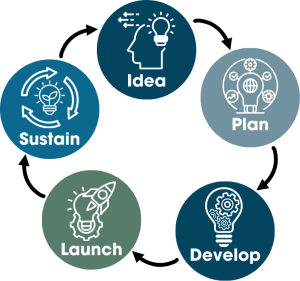
Each section below gives an overview of the phase, along with key milestones in the process:
In the Idea phase, you will learn about the Micro-Credential Framework and approach by completing the Level 1 UMS Micro-Credential Development one-hour training. If you are interested in developing a micro-credential, you will let us know about your idea by completing a brief Interest Form. The form helps us identify the most relevant resources and support needed.
Milestones:
- Complete the training and earn the UMS Micro-Credential Development Level 1 badge.
- Complete the UMS Micro-Credential Development Interest Form.

In the Plan phase, you will form a Development Team and begin planning the development of your micro-credential or micro- badge. You will meet with UMS Micro-Credential Initiative staff, who will share resources to guide you throughout this process. Planning involves learning design with an Instructional Designer and understanding various needs (targeted audience, workforce, etc.). If you are planning to create a revenue-generating micro-credential/badge, you will also create a sustainable business model.
Milestones:
- Submit the Micro-Credential Development Team Members assignment.
- Obtain any required permissions/approvals (e.g., University, Dean, and/or department) from each University involved.
- Plan your design with an instructional designer, then submit the Backward Design Worksheet.

In the Develop Phase, your team will build the learning experience, most often within Brightspace, using the UMS Micro-Credential Learning Design Checklist as a roadmap. Detailed criteria (metadata) are articulated for each badge developed and are then used to create the badges in the UMS badging platform.
Milestones:
- Submit the UMS Micro-Credential or Micro-Badge Metadata Template.
- Using the UMS Micro-Credential Learning Design Checklist, a UMS Instructional Designer conducts a pre-launch design review with the team.

In the Launch Phase, your team will prepare to implement the micro-credential. The team will publish a webpage on your campus or organizational website, determine the registration and enrollment process, and finalize your business model, if revenue-generating.
Milestones:
- Complete the Pre-Launch Checklist.
- Submit the Micro-Credential Implementation Team Members assignment.
- The micro-credential opens for enrollment!

In the Sustain Phase, you will use data and learner feedback to identify and prioritize continuous improvements, a core element of quality-assured UMS Micro-Credentials. You will meet with UMS M-C staff and plan for periodic content review by appropriate subject-matter experts.
Milestones:
- Meet with UMS M-C Staff several months after launch to discuss continuous improvement of the course: content and format, assessments, learner engagement and M-C completion, and feedback.
- Work with UMS M-C Staff to collect micro-credential impact data, and inform them of any changes to personnel and of any issues or needs that arise.
Throughout the process, you will meet with UMS Micro-Credential Initiative Staff to ask questions, address potential barriers and challenges as they arise, and connect with others throughout the System who may be able to offer additional support and expertise.
Next Steps
Ready to get started turing your idea into a reality?
- Enroll in the UMS Micro-Credential Development Level 1 training.
- Complete the UMS Micro-Credential Development Interest Form. Once submitted, the UMS M-C Staff will follow up via email, typically within 5-10 business days. Then, if you wish to continue, you and any identified Development Team members will meet with the UMS Micro-Credential Learning Designer to kick off planning.
Questions?
Contact us at ums.mc@maine.edu.